


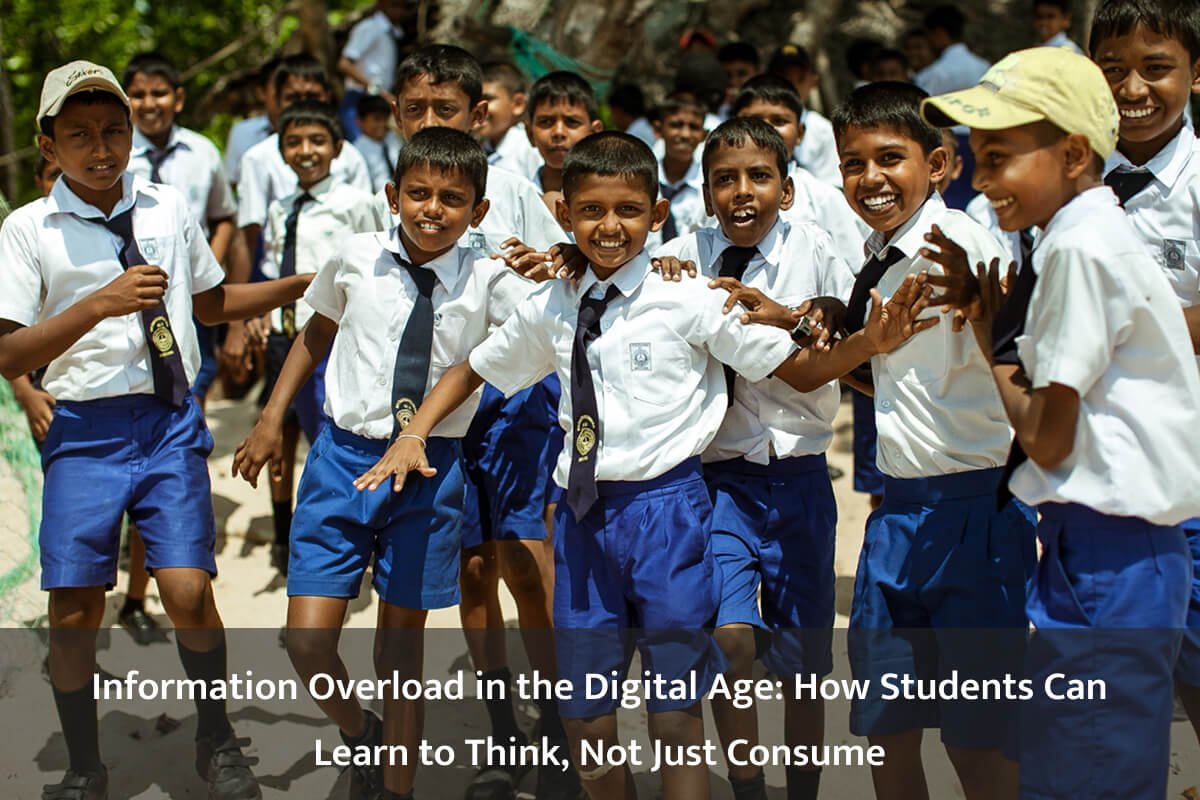
Information Overload in the Digital Age: How Students Can Learn to Think, Not Just Consume
Understanding Information Overload in Today’s World
Information overload is when we get fed more and more info than our brain can really handle, kind of at once. Then it becomes tricky, yeah not only for focusing, but also for making choices and keeping what actually matters in memory.
What Is Information Overload?
Information overload is basically the situation where you get too much information all at once . So, it tends to make things harder to understand, remember and use it in a practical way, without it feeling chaotic.
How the Digital Age Changed Learning
The digital age made learning feel quicker and way more reachable because of online resources. But it also expects students to sort through what matters and not get pulled into distractions too easily.
Sources of Information Students Encounter Daily
Students run into information from social media, websites, AI tools, videos, news feeds, podcasts and online classes. Dealing with all those streams, every day can get pretty difficult.
The Shift From Information Scarcity to Information Abundance
Back then, grabbing almost any info was trickier, but nowadays it hits you right away. The difficulty isn’t so much about access anymore, it is more about picking out what feels credible and really useful.
Why Students Are More Connected Than Ever
With smartphones and the internet around, students can stay linked all day. Okay, this supports learning access, but at the same time it stirs up extra distractions and that never-ending flood of details that can be hard to sort through.
Key Insight Box
Back then, finding info was the hardest part. Now, students get tons of information, but the actual trouble is less about having it, more about figuring out what to trust, what to comprehend, and what to use with care.
Why More Information Doesn’t Always Mean Better Learning
More info doesn’t always turn into better learning. Learning tends to improve when students understand, consider and apply what they learn, not just collect it.
Core Educational Section
Information vs Knowledge vs Understanding
Information is like, facts, knowledge is learning those facts, and understanding is knowing how to use them the right way. Real learning, kind a happens when students truly understand what they’re learning, not just gather small bits.
The Myth That More Content Equals More Learning
Sure , reading or watching more stuff might feel productive, but it doesn’t always make learning better. Usually what matters most is real understanding, plus remembering the information you come across.
Why the Brain Needs Time to Process Information
Your brain really needs time to organize and take in new information. If you pause, take breaks, and revisit what you read, it can help boost learning quite a lot.
Shallow Consumption vs Deep Learning
Scrolling quickly through content tends to create shallow learning. Deep learning is more like students actually thinking, questioning, and connecting ideas together over time.
The Importance of Reflection and Analysis
Reflection helps students get a clearer grasp of what they learned. Doing analysis on the information improves critical thinking, and leads to better choices and decisions later.
Comparison Table
| Information | Knowledge | Understanding |
| Basic facts and data | Learned and organized information | Ability to apply and evaluate knowledge |
| Easily available | Built through learning | Developed through critical thinking |
| Quickly consumed | Meaningfully retained | Used wisely in real-life situations |
Featured Snippet Opportunity
What Is the Difference Between Information and Knowledge?
Information is kind of raw facts, data, and stuff like that. Knowledge is basically that information which has been understood, and it gets learned through lived experience and also through thinking.
How Information Overload Affects Students
When there is too much information, learning can become kind harder, not really easier. It may weaken attention, boost stress, and make it tough for students to think straight and later recall what they went through.
Awareness Section
Reduced Attention Span
Because students are constantly shown digital content, it can get harder to stay locked in. They might bounce between tasks more often, and concentration just slips faster than it should.
Difficulty Concentrating on One Task
Way too many pings and all sort of little distractions, makes it hard to stick with just one thing. so yeah, performance can dip and the whole learning vibe can start to fade.
Increased Mental Fatigue
Working through too much content at once can feel like it drains you mentally. This kind of weariness tends to lower drive and it can also slow down your thinking a bit.
Confusion Caused by Conflicting Information
Because students are constantly shown digital content, it can get harder to stay locked in. They might bounce between tasks more often, and concentration just slips faster than it should.
Information Anxiety and Decision Fatigue
There are simply too many choices, angles, and viewpoints. It can feel a bit much. Students might get stuck while selecting, or they may keep worrying about whether they chose the proper pieces even though they really should just proceed.
Reduced Retention and Recall
When information is taken in quickly, it’s harder to keep the main ideas around. learning usually goes better when the same concepts are revisited, and truly grasped, not just glanced over.
The Challenge of Distinguishing Facts From Opinions
Online, not everything is actually verified or dependable. Students have to rely on critical thinking, to untangle evidence from beliefs and steer clear of misinformation that sounds convincing.
Impact Table
| Effect of Information Overload | Impact on Learning |
| Constant distractions | Reduced focus and attention |
| Too much content | Poor retention and recall |
| Conflicting viewpoints | Confusion and uncertainty |
| Information fatigue | Lower motivation to learn |
The Difference Between Consuming Information and Thinking Critically
You know, just reading or watching information it’s often not enough for learning that actually sticks. Critical thinking makes it so students can question, measure, and use what they hear instead of basically taking it like it’s truth right away, or something.
High-Value Content Gap Section
What Does It Mean to Consume Information?
Consuming information is like reading, watching, or listening to content. Usually it’s more about receiving the ideas without really poking at them. No pushback, no checking, just absorbing.
What Does It Mean to Think Critically?
Thinking critically is sort of analyzing the information first, before you just accept it. It means you ask questions, check the evidence, and then come to a reasonable conclusion even if it makes you wait a little longer, or you know takes more time than expected.
Why Critical Thinkers Ask Questions
Asking questions helps students understand topics in a deeper way. It basically sparks curiosity and it supports better decision-making not just quick answers.
Evaluating Information Instead of Accepting It Blindly
Not every piece of information is accurate or dependable. When students evaluate sources they can spot what’s reliable, and what is more like opinion or noise.
Learning to Analyze, Compare, and Reflect
When students look at different viewpoints, and then kind of ruminate about them, the whole idea clicks a lot clearer. it also improves how they reason over time step by step, slowly but surely.
Becoming an Active Learner Rather Than a Passive Consumer
Active learners interact with information by running it through their mind, and they ask questions, it’s like they are actually working with it. Passive learners usually just take it in, as if they are simply ingesting the content, with no real deeper insight, you know.
Comparison Table
| Information Consumer | Critical Thinker |
| Accepts information quickly | Evaluates information carefully |
| Focuses on content quantity | Focuses on the quality of content |
| Reacts to information | Analyzes information before responding |
| Seeks answers | Asks thoughtful questions |
Why Critical Thinking Is Becoming More Important Than Memorization
Back when information was kind harder to get, memorizing facts could feel like the big win. But these days everything pops up pretty fast, in seconds, so “knowing” feels less like a main thing and more like something else.
Future-Ready Skills Section
The Rise of AI and Instant Information Access
With AI tools and search engines, information arrives almost immediately. Because of that, being able to evaluate what you find and then use it properly has turned into the real advantage.
Why Facts Alone Are No Longer Enough
Facts still matter , yes, but in this messy world they’re not the complete story. Students have to learn how to read between the lines, tear down the ideas, and use information in situations that don’t look exactly the same every time.
Problem-Solving in a Complex World
A lot of today’s problems don’t come with clean instructions. They often ask for creative thinking, plus flexible problem-solving.
Making Informed Decisions
Critical thinkers, check the evidence first, before they commit. This habit leads to better outcomes in school, at work and in everyday life too, especially when choices pile up pretty fast.
Understanding Multiple Perspectives
People often have different opinions and different starting points. Critical thinking lets students really listen spot those perspectives, and land on conclusions that feel more even not one sided like a single note on repeat.
The Skills Employers and Society Need
Employers often want more than those good grades. They want real problem solving, clear communication, a flexible way of thinking and some steadier decision making. Not just, you know, academic performance.
Writer Instructions
So basically, critical thinking gets students ready for future careers because they learn how to reason it through, ask better questions, and not just take the first answer.
Common Digital Habits That Reduce Deep Learning
Constant scrolling and multitasking , with frequent notifications and switching between apps, can make focus more flaky and it’s harder to really grasp and recall the information in a deep way.
Student-Focused Section
Endless Scrolling
That constant scrolling puts students in front of too much content at once. It tends to reduce focus, and it also nudges people toward pretty shallow learning.
Multitasking During Study Time
Going back and forth between studying and apps makes concentration slip, even if it feels “quick”. Doing one thing at a time helps learning stick and move forward.
Consuming Short-Form Content Excessively
Watching only short videos can shrink patience for deeper work. Complicated topics usually need more time, and more deliberate attention.
Reading Headlines Without Understanding Context
Headlines are basically just a small slice of the bigger story. Taking a minute for the full text helps students see the whole picture.
Overreliance on Quick Answers
Fast answers save a bit of time, sure, but they might reduce independent thinking. Learning often improves when students explore first, and solve problems by themselves.
Information Without Reflection
Reading passively, without thinking through the meaning, limits how well ideas land. Reflection helps students remember, and also use what they learned later.
Digital Distractions and Notification Culture
Notifications keep interrupting concentration, and they break the study flow. When distractions are limited, focus gets stronger, and productivity usually goes up.
Myth vs Reality Table
| Myth | Reality |
| Multitasking improves productivity | It often reduces focus and learning. |
| More information means more learning | Understanding is more important than quantity. |
| Quick answers equal knowledge | Real knowledge develops through reflection and practice. |
How Students Can Develop Stronger Thinking Skills
Stronger thinking skills usually don’t show up overnight, they come from everyday practice and sort of calm, mindful study habits. Even small daily moves like pausing before answering or re checking what you read can make students more thoughtful, genuinely curious and a bit more assured as learners.
Practical Action Section
Ask Better Questions
Try asking questions like “why”, “how”, and “what if” so the topic doesn’t stay kind of surface level.
Verify Sources Before Accepting Information
Before you accept or even pass along information, see if it comes from credible, reliable sources not just something that sounds right.
Compare Different Perspectives
Look at more than one viewpoint, that way students can form a steadier understanding of what’s going on, instead of grabbing only the loudest idea.
Practice Reflective Thinking
Read Past Headlines Go through the whole article, rather than just trusting headlines for your information.
Engage in Discussions and Debates
Talking things through with others helps reasoning grow, and it also sharpens communication, along with critical thinking in general.
Read Beyond Headlines
Take a moment, to pause and, reflect on what you learned and how it seems to trail back to what you already know. This kind of brain linking, matters more than most folks realize, honestly.
Keep a Learning Journal
Write down main ideas, lingering questions and the lessons you take away. Over time this supports understanding and memory, in a practical way.
Apply What You Learn to Real-Life Situations
Apply new knowledge to day to day situations, that helps students deepen comprehension, not just “remember for a test”.
Featured Snippet Opportunity
7 Ways Students Can Improve Critical Thinking Skills
- Ask questions Question what you read, instead of taking everything as is , like all that stuff is automatically true.
- Verify information Double check the facts using trusted and dependable sources before you believe it, or worse share it.
- Read diverse sources Try to check a few different viewpoints, so you get a more even angle , and not only one tight way of thinking.
- Reflect regularly Make time to sit with it , like what you’ve learned and how it connects back to things you already know , or even what you used to think you knew.
- Participate in discussions Share your thoughts , and also listen to other people so your understanding gets honed , and your point of view can actually shift a bit.
- Analyze evidence Look at the evidence and the facts before you form an opinion, or make a decision that you’ll later rethink.
- Stay curious Keep learning and wandering into new ideas with an open mind, even when you’re unsure yet , and you’re still figuring it out.
The Role of Media Literacy in Modern Education
Media literacy kind helps students understand, sift through and use information in a responsible way. it is a key skill for learning, making choices that make sense.
Sakal NIE-Relevant Section
What Is Media Literacy?
Media literacy is the ability to access, comprehend, assess, and also produce information from various media sources.
Why Media Literacy Matters for Students
It kind of helps learners notice the solid information, it supports them in thinking critically, and then make well-informed decisions, without just absorbing whatever is said.
Identifying Reliable and Unreliable Sources
Students should look at the source first, then the author, and also the evidence, before believing anything. kind of simple but it works.
Understanding Bias and Perspective
Pretty much every source carries some kind of angle, or viewpoint. recognizing those different perspectives, helps build a fuller understanding.
Spotting Misinformation and Fake News
Students should double-check the claims, and avoid reposting it along unless they verify whether it is accurate.
Becoming a Responsible Digital Citizen
A responsible digital citizen uses technology in a thoughtful, kind a steady way, treats people with respect online and shares information that is true not only convenient or fast also quick.
Media Literacy Checklist
- ✅ Check the source Make sure it comes from something trusted and real.
- ✅ Verify facts Cross-check before believing or even passing it along.
- ✅ Read beyond headlines Understand the whole thing not just the title.
- ✅ Compare multiple viewpoints Use more than one source for a steadier perspective.
- ✅ Think before sharing Only spread information that is accurate, and also responsible.
How Parents and Schools Can Help Students Navigate Information Wisely
Parents, teachers they both matter a lot in helping students handle information wisely. If they nudge curiosity, promote conversation, and teach steady digital routines, students can slowly build better critical thinking. Not perfect overnight of course, but it adds up.
Parent & Teacher Section
Encouraging Question-Based Learning
Instead of making students just memorize answers, have them ask little things, get curious, and keep moving forward like, even when it’s not perfect.
Creating Discussion-Oriented Classrooms
Let students trade ideas, pose questions ,and actually learn from other perspectives even if it feels kind uncomfortable at first, that’s okay.
Promoting News-Based Learning
Use current news pieces so classroom topics connect to what’s happening in the world, right now.
Teaching Students How to Evaluate Sources
Help students look at the source first, then check the evidence and credibility… before they accept anything as true.
Supporting Healthy Digital Habits
Encourage regular breaks, short focused study stretches ,and a mindful way of using screens and devices so it stays balanced.
Helping Students Balance Technology and Reflection
Use technology for learning, sure, but also make room for thinking time, discussion, and quiet reflection on new concepts.
Turning Everyday News into Learning Opportunities
Bring up the daily news with students, invite them to question what they hear and then sort out different viewpoints together step by step, bit by bit.
Writer Instructions
Align this section with Sakal NIE’s philosophy, by nudging curiosity, promoting informed thinking and keeping an attentive mind through real-world learning, real talks that matter, and a responsible way of using information.
From Information Consumers to Independent Thinkers
The point of education isn’t only to drop facts in front of students, it’s also to help them think for themselves. Good thinking skills set them up for lifelong learning and whatever comes next, like new problems, new changes, and new expectations.
Thought Leadership Section
Why Independent Thinking Matters
People who think on their own make considered choices, not just do what other people do. It’s more than “following”, it’s making sense of things.
Building Confidence Through Critical Analysis
When students analyze information, they start trusting their own reasoning a little more. They get comfortable with their ideas and with the decisions they make, even when it’s not perfect right away.
Learning How to Learn
Students who really understand learning can, shift when new info shows up later in life. They don’t just freeze they’re adjust and keep moving on, even if it feels messy at first.
Preparing Students for an Uncertain Future
Critical thinking helps students manage tough situations and also adapt in a world that changes fast, and keeps changing. It’s kind like survival but not only that, more like growth you know.
Developing Lifelong Learning Habits
Curiosity, along with continuous learning kind of helps them for the long haul. They just keep widening their understanding across their entire lives, not only on class days, really.
Thinking Beyond the Screen
Real learning comes from thinking, discussing and applying knowledge, not just eating up digital content. Watching isn’t the same as understanding.
AI Overview Opportunity
How Students Can Avoid Information Overload
- Focus on quality over quantity Choose sources that feel credible and genuinely useful, not just random material.
- Verify sources Confirm that where you got the info from is dependable , reliable and comes from trustworthy places.
- Limit distractions Try to reduce notifications and avoid unnecessary multitasking while you are learning.
- Reflect on what they learn Think back a moment and link the fresh ideas to what you already have in your head, even if it feels a little loose, so it all starts to click.
- Practice critical thinking Don’t just accept the info question it, look at the evidence and reach your own conclusions.
Conclusion
Information Is Everywhere, Understanding Is Rare
Info is simple to grab yet real understanding comes from thinking in a deeper way about what we actually learn. Real learning shows up when we question things and then use what we learned not just store it.
The Goal Is Not More Information, But Better Thinking
Learning is not about piling up extra facts , more like building smarter choices with the information we already have. Solid thinking habits matter far more than endless streams of content.
Future Success Depends on Critical Thinking Skills
Critical thinking helps students sort out problems, shift direction when things change, and choose actions based on evidence. It’s a skill type that stays relevant through school, work and daily life too.
Closing Takeaway
In a world that is full of info, the ability to think critically feels more valuable than just knowing more. Students who question , judge, and put knowledge to use are more ready for what comes next.
FAQ Section
- What is information overload and how does it affect students? Information overload is basically when students get too much information all at once, maybe more than they can really process.
- Why is critical thinking important in the digital age? It also helps people sort through facts and pull them apart from misinformation and it honestly supports wiser decisions and stronger problem solving, not just fast answers.
- How can students avoid information overload? Students can stick to dependable sources, reduce distractions, and actually pause to think about what they learned. That reflection part makes the information sink in more, instead of just passing through.
- What is the difference between information consumption and critical thinking? Information consumption is kind of like taking in information, sort of absorbing you know, without going much further. Critical thinking feels more like questioning what you get, examining it carefully, and then using it in a more meaningful way not just keeping it sitting there.
- How does media literacy help students make better decisions? Media literacy helps students notice dependable information and it sort of trains them to catch when something is trying to mislead or gently guide your viewpoint. After that they can decide with more clarity and move forward in a more responsible way too.

Leave a Reply