


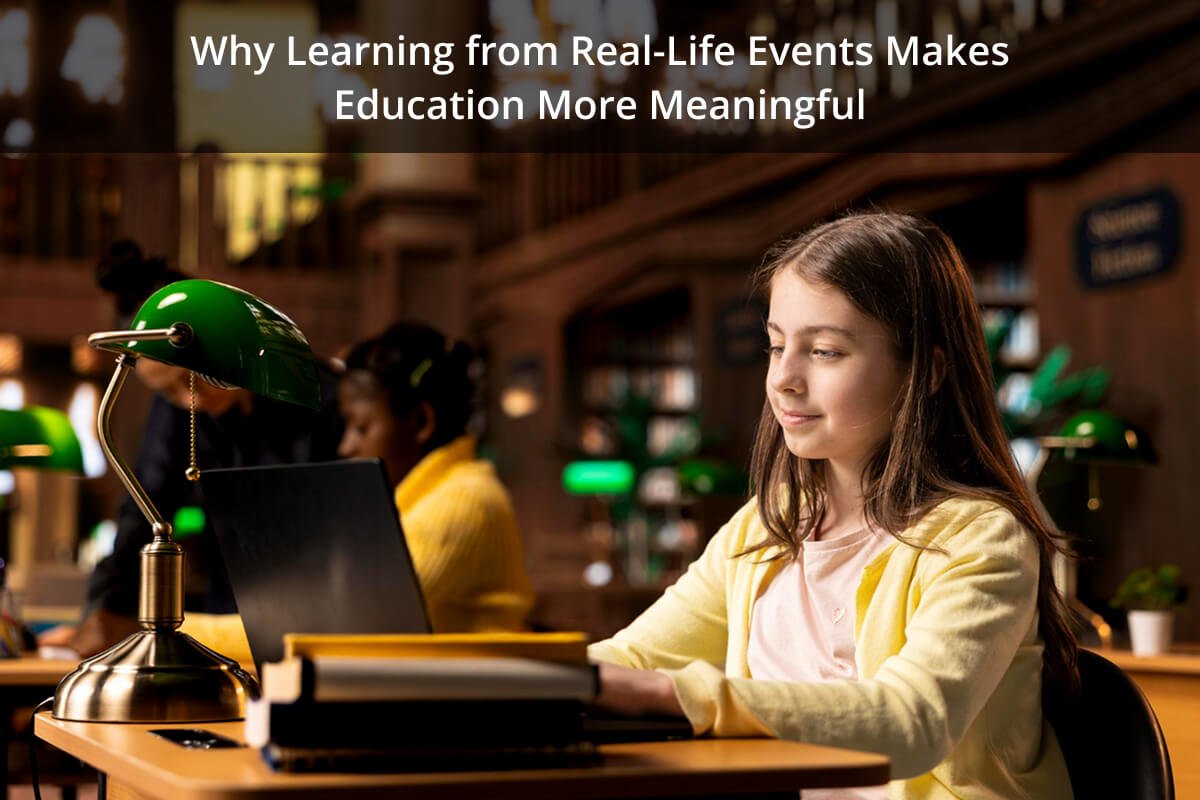
Why Learning from Real-Life Events Makes Education More Meaningful
For generations, education has been associated with classrooms, textbooks, exams, and grades. While these constructions determine organization and uniformity, many learners—children and persons alike—frequently feel a breach between what they study and the realm they really servant. This disconnect is not coincidental; it is the result of knowledge plans that prioritize content childbirth over lived understanding.
Real-life education admonishes us that education is not just readiness for existence—it is history itself. When knowledge connects to knowledge, passion, and truth, it becomes significant, significant, and life-changing.
Why Traditional Learning Often Feels Disconnected
Traditional learning environments frequently emphasize abstract concepts, standardized exams, and rote memorization. While this approach may help students reproduce information, it often feels distant from their lived experiences.
Students are requested to remember formulas without observing their pertinence, study ancient events outside understanding their new echoes, and act in advance of exams that rarely mirror original-realm challenges. As a result, education can feel mechanical alternatively significant. When instruction is disconnected from common history, graduates struggle to see reason information matters, chief to disengagement and trivial understanding.
What We Mean by Real-Life Learning
Real-life learning refers to learning that emerges from events, situations, stories, relationships, and lived realities—not just from curriculum content.
It involves education from discourses, observations, mistakes, friendly interplays, topical news items, and personal occurrences. Real-life education does not deny academic information; instead, it estates it in circumstances. It helps learners link ideas to realism, making education appropriate, human, and applicable further the study hall.
How Humans Naturally Learn from Experience
Humans are wired to learn through experience long before formal education begins.
Children learn by observing others, imitating behaviors, reflecting on outcomes, and experimenting through trial and error. They watch, try, fail, adjust, and try again. This natural learning process is intuitive and deeply effective. Experience-based learning engages multiple senses, emotions, and cognitive processes, making understanding more robust than passive instruction alone.
The Limits of Textbook-Only Education
Textbooks are valuable resources, but they have limits when used in isolation.
Information presented without context often fades quickly because it lacks emotional or experiential anchors. When learners cannot relate content to real situations, knowledge remains abstract and fragile. Textbook-only education risks creating learners who know about things but do not know how to use or interpret them in real life.
Real-Life Context Creates Deeper Understanding
Context transforms information into comprehension.
When concepts are placed within real-life scenarios, learners understand not just what something is, but why it matters and how it works. Context allows learners to see relationships, consequences, and applications. This depth of understanding leads to flexible thinking, where knowledge can be adapted to new situations rather than recalled only in familiar formats.
Emotional Engagement and Memory Retention
Learning is not purely cognitive—it is deeply emotional.
Emotions strengthen recall because emotionally charged experiences activate stronger memory pathways. Personal relevance increases attention, making learners more invested in the material. Experiences anchor learning by connecting ideas to feelings, moments, and stories. When learners care, they remember. Real-life learning naturally engages emotions, making retention stronger and longer-lasting.
Learning Through Observation, Not Instruction
Much of what we learn comes from watching the world around us.
By observing real situations—how people solve problems, handle conflict, or make decisions—learners gain insights that explanations alone cannot provide. Observation helps learners notice nuance, complexity, and context. It teaches lessons that are difficult to capture in instructions but essential for real-world competence.
Critical Thinking Born from Real Situations
Critical thinking flourishes in real contexts where answers are not predetermined.
Real-life situations require problem-solving, questioning assumptions, weighing options, and reasoning through uncertainty. Unlike textbook problems with fixed solutions, real-world challenges are messy and ambiguous. Engaging with such situations helps learners develop judgment, adaptability, and independent thinking—skills critical for life beyond exams.
Values, Empathy, and Social Awareness
Real-life experiences are powerful teachers of values.
Through real events and interactions, learners encounter ethical dilemmas, diverse perspectives, and social realities. These experiences cultivate empathy by helping learners understand others’ feelings and circumstances. They also build social awareness and ethical reasoning, which cannot be taught effectively through rules alone. Values are formed through lived understanding, not memorization.
When Mistakes Become Powerful Teachers
In real-life learning, mistakes are not failures—they are feedback.
When learners are allowed to make mistakes without fear of punishment, they gain insight into consequences and improvement. Failure becomes a source of learning rather than shame. This mindset builds resilience, encourages experimentation, and fosters growth. Real-life learning reframes mistakes as essential steps in understanding.
Bridging the Gap Between Knowledge and Application
One of the greatest challenges in education is applying theory to practice.
Real-life learning bridges this gap by giving learners opportunities to use knowledge in practical contexts. When learners apply concepts, confidence grows. They begin to trust their ability to think, adapt, and respond. Application transforms passive knowledge into active competence.
Role of Teachers in Facilitating Real-Life Learning
Teachers play a crucial role as facilitators of real-life learning.
Rather than only delivering content, they guide reflection, encourage discussion, and help students connect experiences to concepts. Teachers help learners make sense of events, draw insights, and articulate understanding. Their role shifts from information providers to meaning-makers, supporting deeper learning.
Preparing Students for Uncertainty and Change
The real world is unpredictable, and education must reflect this reality.
Real-life learning prepares students for uncertainty by developing adaptability, resilience, and decision-making skills. When learners engage with open-ended situations, they learn to navigate ambiguity rather than fear it. This preparation is essential for a rapidly changing world where flexibility matters more than fixed answers.
Examples of Real-Life Learning in Everyday Education
Real-life learning can be integrated into everyday education in many ways.
Discussions around current events help learners connect academics to the world. Community projects provide hands-on experience and social responsibility. Case studies and storytelling allow learners to explore complex situations safely. Reflective conversations encourage learners to process experiences and extract meaning. These practices make learning alive and relevant.
Why Meaningful Learning Stays for Life
Meaningful learning shapes identity and lifelong thinking.
When learning is connected to lived experience, it becomes part of who we are, not just what we know. Such learning influences how we think, decide, and relate to others throughout life. Unlike memorized facts that fade, meaningful understanding endures because it is woven into personal experience.
FAQs About Experiential Learning
Experiential learning raises important questions, especially in traditional education systems. Below are detailed responses to common concerns.
Q1. What is real-life or experiential learning?
Experiential learning is learning through direct experience, reflection, and application. It involves engaging with real situations, events, and challenges, then thinking critically about them. This approach emphasizes understanding over memorization and prepares learners for real-world complexity.
Q2. Is experiential learning suitable for all ages?
Yes, experiential learning is suitable for all ages.
Young children naturally learn through play and exploration, while older students benefit from projects, discussions, and real-world problem-solving. The form of experiential learning may change with age, but the principle—learning through experience—remains effective throughout life.
Q3. Can real-life learning replace textbooks?
Real-life learning does not replace textbooks; it complements them.
Textbooks provide structure and foundational knowledge, while experiential learning provides context and application. Together, they create a balanced education where knowledge is both accurate and meaningful.
Q4. How does experiential learning improve retention?
Experiential learning improves retention by engaging emotions, senses, and active participation.
When learners experience concepts rather than just read about them, they form stronger memory connections. Reflection further reinforces understanding, making learning more durable and transferable.
Q5. What role do schools play in real-life learning?
Schools play a vital role in creating opportunities for real-life learning.
By encouraging discussion, project-based learning, community engagement, and reflective practices, schools can bridge the gap between curriculum and life. Schools that value experiential learning prepare students not just for exams, but for living thoughtfully and responsibly.
Key Takeaways
Learning becomes meaningful when it connects to life.
Experience deepens understanding beyond memorization. Emotions and context strengthen retention and engagement. Real-life learning prepares students for the complexity, uncertainty, and humanity of the real world. When education honors lived experience, it equips learners not just to succeed academically, but to grow as thoughtful, capable individuals.

Leave a Reply