


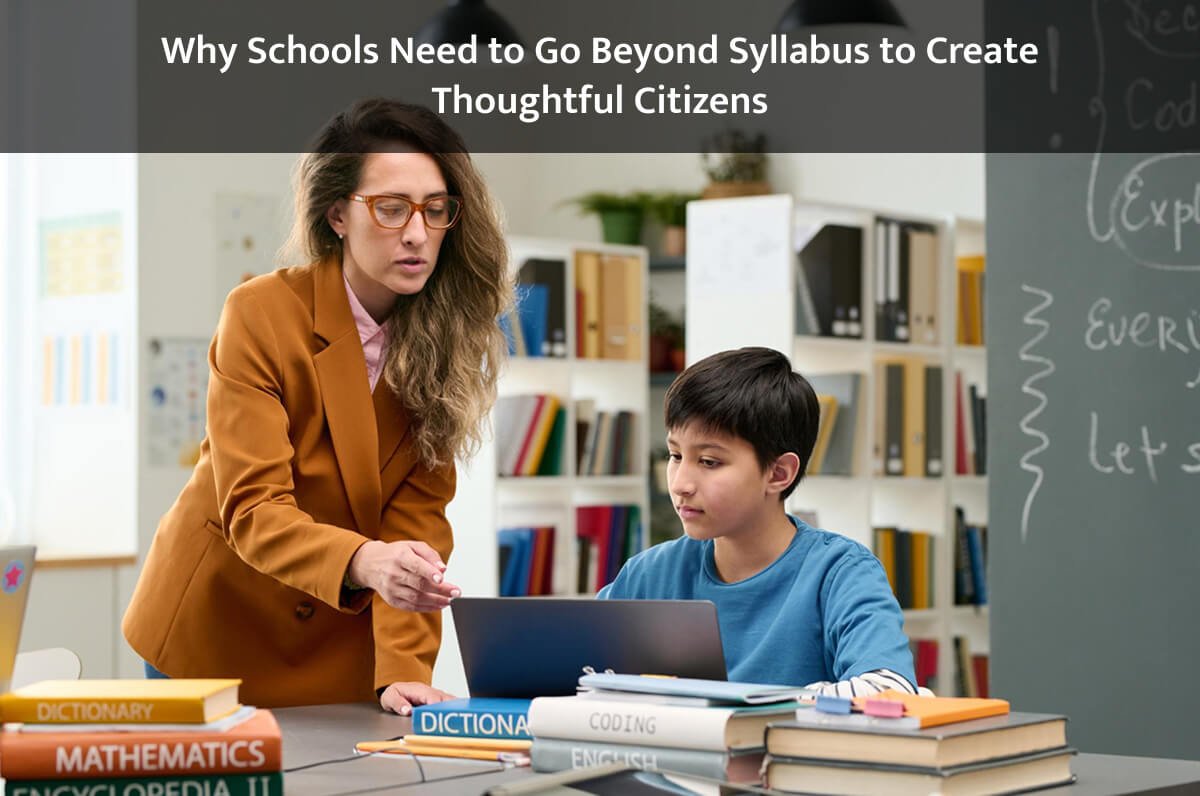
Why Schools Need to Go Beyond Syllabus to Create Thoughtful Citizens
Why Completing the Syllabus Is No Longer Enough
For decades, education has been measured by how much content is covered and how well students perform in exams. Schools proudly announce syllabus completion, revision schedules, and results, believing these indicators reflect success. Yet, as societies face increasing polarization, misinformation, social challenges, and ethical dilemmas, an uncomfortable question emerges: Is academic completion enough to prepare students for the world they are inheriting?
Education is not only about producing skillful artists; it is about forming aware, accountable, and contemplative villagers. This blog investigate reason achieving the syllabus is not any more enough and by virtue of what schools must evolve to nurture community knowledge, fault-finding thinking, and social trustworthiness alongside academic superiority.
Modern instruction systems frequently treat the summary as the last goal. Teachers feel bothered to “finish the portion,” scholars rush from episode to chapter, and knowledge enhances equivalent with inclusion alternatively understanding.
Syllabus completion prioritizes what is instructed over in what way or manner and reason it is understood. It focuses on bringing facts instead of construction awareness, blame, or perspective. Students can remember gospels, formulas, and definitions, yet struggle to request bureaucracy intentionally to real-life positions or social issues.
More basically, an education order consumed accompanying completion frequently sidelines principles, criticism, and accountability. It produces learners the one see content but lack framework, who act well in exams but feel confused from people. In a rapidly changeful realm, instruction must aim not just to inform minds, but to shape doom, knowledge, and blame.
What Does It Mean to Be a Thoughtful Citizen?
Citizenship is often reduced to legal status or civic duties like voting. But being a thoughtful citizen goes far beyond these formal definitions. It is about how individuals understand themselves in relation to others and society as a whole.
A mindful citizen shows knowledge—of friendly issues, inequalities, and composite challenges. They show understanding, perceiving the experiences and excitements of possible choice, even when they disagree from their own. They practice critical thinking, interrogation facts, resolving perspectives, and resistant blind agreement. And they energetically participate in people, either through talk, responsibility, or moral operation.
Education plays a critical role in forming these characters. Schools are frequently the first spaces place babies encounter variety, debate ideas, and discover about joint trustworthiness. When education nurtures introspective place of birth, it prepares juniors not just to succeed separately, but to donate intentionally to society.
The Limits of Exam-Centric Education
Exams have long been the dominant measure of success in education. While assessment is necessary, an exam-centric system comes with significant limitations.
Most exams reward memory, speed, and accuracy under pressure. They prioritize correct answers over thoughtful reasoning, and recall over judgment. As a result, students learn to focus on what will be tested rather than what truly matters.
Values, ethics, empathy, and civic responsibility are difficult to measure in standard exams, so they are often neglected. Students may achieve high scores while lacking the ability to navigate moral dilemmas, evaluate information critically, or engage respectfully with differing opinions. An education system that values only what can be tested risks ignoring what is essential for societal well-being.
Knowledge Without Context: A Missing Link
Knowledge, when taught in isolation, often fails to leave a lasting impact. Facts without context become abstract, disconnected, and easily forgotten.
When students learn historical events without discussing their relevance to current social issues, or study science without connecting it to environmental responsibility, learning feels distant from reality. Without real-world connections, knowledge does not shape perspective or behavior.
Context helps students understand why knowledge matters. It allows them to see how information influences decisions, policies, and human lives. Education that integrates context transforms learning from passive consumption into meaningful understanding.
Critical Thinking as a Civic Skill
Critical thinking is not just an academic skill; it is a civic necessity. In an age of misinformation, polarized narratives, and digital overload, the ability to think critically determines how responsibly individuals engage with society.
Critical thinking involves evaluating sources, questioning assumptions, and recognizing bias. It empowers students to form independent opinions rather than absorbing dominant narratives uncritically. It also teaches humility—the ability to revise one’s views when presented with new evidence.
Schools that prioritize critical thinking help students become informed citizens who can engage thoughtfully with social, political, and ethical issues. This skill strengthens democracy, dialogue, and collective decision-making.
Awareness of Society, Not Just Subjects
Education often confines learning within subject boundaries, but real life does not operate in silos. Students need awareness of the society they live in, alongside academic knowledge.
Understanding social issues such as inequality, environmental challenges, and public health builds empathy and responsibility. Learning about civic responsibilities—rights, duties, and participation—helps students see themselves as active contributors. Awareness of current events connects classroom learning to real-time realities. Exposure to community realities fosters grounded understanding beyond textbooks.
This broader awareness helps students contextualize academic content and develop a sense of belonging and accountability within society.
Values, Ethics, and Moral Reasoning in Schools
Values are not automatically developed; they must be nurtured through experience, discussion, and reflection. Schools play a critical role in shaping moral reasoning.
Teaching values is not about enforcing beliefs, but about encouraging ethical thinking. When students discuss dilemmas involving fairness, responsibility, and integrity, they learn to weigh consequences and consider others’ perspectives.
Moral reasoning helps students make decisions guided by principles rather than convenience. It prepares them to navigate complex real-world situations where rules alone are insufficient. Schools that integrate values into learning cultivate character alongside competence.
Learning to Question, Not Just Accept
One of the most important outcomes of education should be the ability to question thoughtfully. Yet, many classrooms reward compliance over curiosity.
Learning to question involves curiosity, dialogue, and respectful disagreement. It teaches students that disagreement is not disrespect, and that understanding grows through discussion. Questioning encourages deeper engagement with ideas rather than passive acceptance.
When students are encouraged to ask “why” and “how,” they develop intellectual independence. This habit prepares them to engage critically with authority, media, and societal norms—an essential trait of responsible citizenship.
Emotional Intelligence and Social Responsibility
Emotional intelligence underpins social responsibility. Understanding one’s emotions, regulating reactions, and empathizing with others shape how individuals interact within society.
Students with strong emotional intelligence are better equipped to handle conflict, collaborate effectively, and respond compassionately to others’ struggles. These skills are essential for collective well-being.
Schools that acknowledge emotions as part of learning help students become more self-aware and socially conscious. Emotional intelligence bridges the gap between knowledge and humane action.
Understanding Diversity, Inclusion, and Empathy
Modern societies are increasingly diverse, and education must reflect this reality. Exposure to different perspectives, abilities, cultures, and backgrounds helps students develop empathy and inclusion.
Understanding diversity goes beyond tolerance; it involves recognizing systemic inequalities and appreciating lived experiences different from one’s own. Inclusive education challenges stereotypes and encourages respect.
When students learn in environments that value diversity, they become more adaptable, open-minded, and socially responsible. These qualities are essential for peaceful coexistence and collaborative problem-solving.
Real-Life Issues as Learning Opportunities
Real-life issues provide some of the richest learning opportunities available. News stories, community challenges, and social movements offer powerful contexts for discussion and reflection.
Using current events as learning tools helps students connect theory to reality. It encourages analysis, debate, and ethical reasoning. Real-world issues also make learning relevant and engaging, showing students that education is not separate from life.
When classrooms engage with real-life challenges, students learn that knowledge has purpose and impact.
Role of Teachers as Mentors and Guides
In a citizenship-focused education model, teachers are more than content deliverers—they are mentors and guides.
Teachers facilitate discussions, encourage reflection, and model thoughtful behavior. Their attitudes toward dialogue, disagreement, and empathy shape classroom culture. By demonstrating curiosity, fairness, and respect, teachers influence students far beyond academics.
This mentorship role builds trust and creates spaces where students feel safe to explore ideas and values.
Creating Spaces for Dialogue and Debate
Dialogue and debate are essential for developing reasoning and civic awareness. Classrooms should function as safe spaces where students can express ideas without fear of ridicule.
Respectful debate teaches students to articulate opinions, listen actively, and engage with opposing views constructively. These experiences mirror democratic participation and prepare students for societal engagement.
When dialogue is valued, learning becomes collaborative and dynamic.
Balancing Academic Excellence with Civic Awareness
There is a common fear that focusing on civic awareness will dilute academic rigor. In reality, the opposite is true.
Awareness enhances learning by making it meaningful. When students understand the relevance of what they study, engagement increases. Critical thinking, discussion, and reflection deepen comprehension and retention.
Academic excellence and civic awareness are not competing goals—they are complementary outcomes of holistic education.
What Future-Ready Schools Should Look Like
Future-ready schools must evolve beyond traditional models. They should emphasize experiential learning, where students apply knowledge in real contexts. Discussion-based classrooms should encourage dialogue and inquiry. There must be a strong emphasis on values and awareness, integrated naturally into learning. And education should include the integration of real-world contexts, making learning relevant and purposeful.
Such schools prepare students not just for exams, but for life.
FAQs About Education and Citizenship
As education shifts toward broader goals, many questions arise about the role of schools in shaping citizens.
Q1. Why should schools focus on citizenship, not just academics?
Schools shape future members of society. Academic knowledge without civic awareness can lead to skilled individuals who lack social responsibility. Citizenship education ensures students understand their role in a shared world.
Q2. Can civic awareness be taught in classrooms?
Yes. Civic awareness can be nurtured through discussions, real-life examples, reflective activities, and ethical debates. It does not require separate subjects but thoughtful integration.
Q3. Does this reduce focus on academic performance?
No. Civic awareness enhances academic performance by increasing engagement, critical thinking, and relevance. Students learn better when they understand why learning matters.
Q4. How can schools teach values without imposing beliefs?
By encouraging dialogue rather than instruction. Schools can present scenarios, ask questions, and promote reflection, allowing students to form their own ethical understanding.
Q5. What role do parents play alongside schools?
Parents reinforce values and awareness through everyday conversations, modeling behavior, and engagement with social issues. Education is most effective when schools and families work together.
Key Takeaways
Education must go beyond syllabus completion. Thoughtful citizens need awareness, values, and critical thinking. Real-world context strengthens learning and deepens understanding. Schools shape not just careers, but society itself.
When education embraces this broader purpose, it prepares students not only to succeed, but to contribute meaningfully to the world they inhabit.

Leave a Reply